
Project Overview
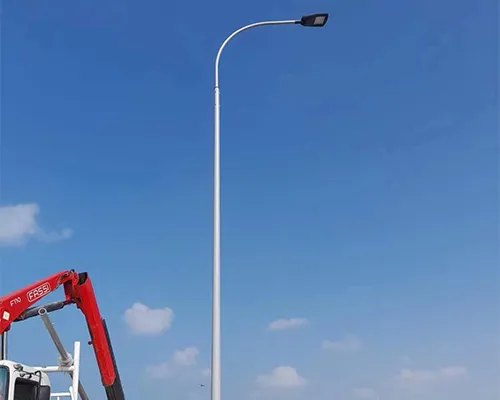
This project involved 110 aluminum davit arm light poles supplied for a roadway lighting application in Oman in 2022.
- Location: Oman
- Year: 2022
- Product: Aluminum davit arm light pole
- Nominal height: 10 m
- Project quantity: 110 sets
The davit-arm configuration provides outreach over the roadway while keeping the pole shaft and luminaire mounting arrangement integrated into one coordinated system.
Project-Specific Engineering Considerations
Final pole dimensions, wall thickness, arm geometry, base connection and foundation requirements must be confirmed from the approved project drawings and local design criteria. Important inputs include the site wind speed, luminaire effective projected area, mounting height, arm outreach, cable routing and corrosion environment.
For coastal or high-temperature locations, the selected aluminum alloy, surface finish, fasteners and isolation between dissimilar metals should be reviewed as one corrosion-control system. Learn more in our coastal corrosion protection guide.
Related Product and Design Resources
See our aluminum davit light pole page for available configurations. For structural planning inputs, review the light pole wind load calculation guide.
Project requirements vary by site. Send the required height, arm dimensions, luminaire data, installation method and design wind speed to Yaolong for an engineering review and quotation.
What the davit arm changes
A davit arm positions the luminaire beyond the pole centerline, so its outreach and mounting angle should be set from the roadway lighting plan. The same nominal 10 m height can lead to different structural demands when the arm length or fixture changes. For a comparable order, buyers should provide the luminaire cut sheet rather than assuming that a standard arm will accept any fixture.
The approval drawing should also settle the cable path through the arm, access-door position, connection to the base and finish. These details affect fabrication and site installation. The 110-set quantity describes this Oman project, but the final design criteria should always come from the actual road and local site conditions.