
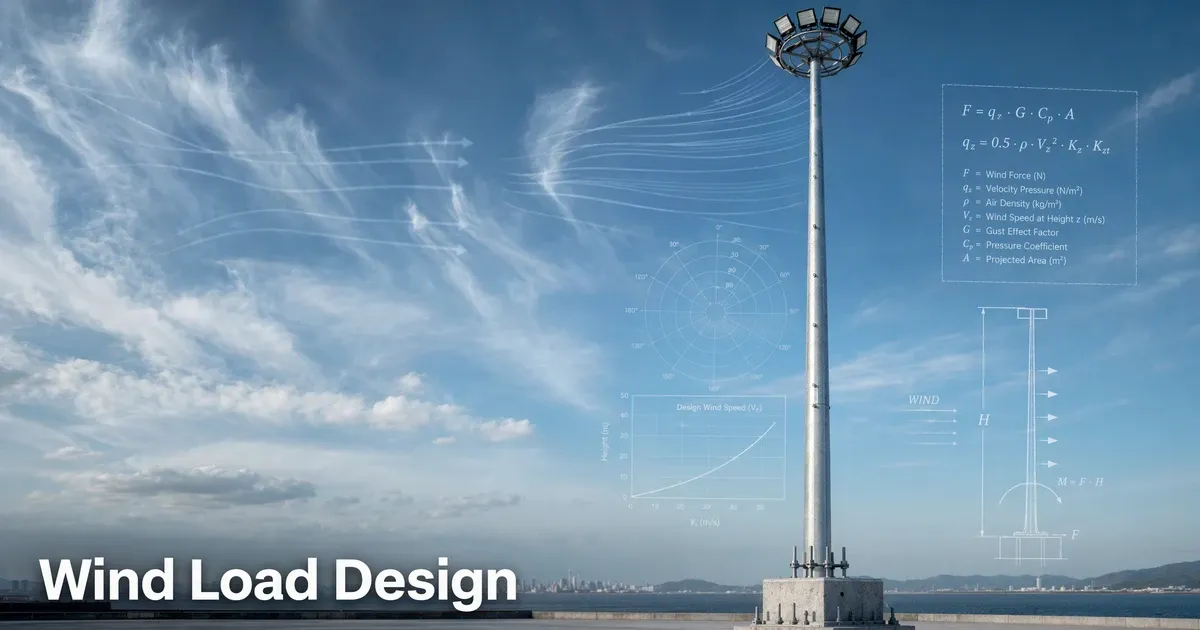
Wind-load calculation is one of the most important steps in light pole selection. A pole that is suitable for one site may be unsuitable for another even when the height and material are identical. Final design should be completed or approved by a qualified engineer using the governing local code, but buyers can improve accuracy by supplying the correct project inputs.
Key inputs in a light pole wind-load calculation
Design wind speed and code
The required wind speed must come from the applicable building or structural standard for the project location. Confirm whether the value is ultimate or allowable stress design wind speed and whether local authorities require special factors.
Exposure and terrain
Open coastal land, flat terrain, suburban development and dense urban areas create different wind exposure conditions. Topographic effects may also increase wind pressure on hills, ridges or escarpments.
Pole height and geometry
Wind pressure acting higher above ground produces a larger overturning moment. Shaft diameter, taper, shape and wall thickness influence both wind area and structural capacity.
Effective projected area
The effective projected area (EPA) combines the projected area of an attachment with its aerodynamic drag. Include every luminaire, bracket, arm, solar panel, camera, banner and sign. A future attachment should not be added unless the pole was designed for it.
Simplified calculation concept
At a conceptual level, wind force is related to velocity pressure, drag and projected area. The force on each component acts at a height above the base, creating bending moment. Engineers then check the shaft, welds, base plate, anchor bolts, foundation interface and serviceability criteria.
A simplified screening calculation is not a substitute for a sealed structural design. Dynamic response, gust effects, fatigue, vortex shedding and local code requirements may also need consideration.
Information to send the pole manufacturer
- Exact installation location
- Applicable design code and wind-speed basis
- Pole height and mounting type
- Fixture manufacturer, model, quantity, weight and EPA
- Arm length, rise and orientation
- Other attachments and their installation heights
- Foundation or anchor-bolt constraints
Common wind-load mistakes
- Using fixture weight instead of EPA
- Omitting arms, banners, cameras or solar panels
- Comparing poles designed to different wind speeds
- Assuming a taller version has the same capacity
- Changing accessories after the pole has been engineered
Select an engineered pole
Yaolong supplies light poles for road, area, sports and high-mast applications. For tall installations, review our high mast lighting poles. Submit the site criteria and complete attachment schedule through our contact page so the correct pole configuration can be evaluated.