
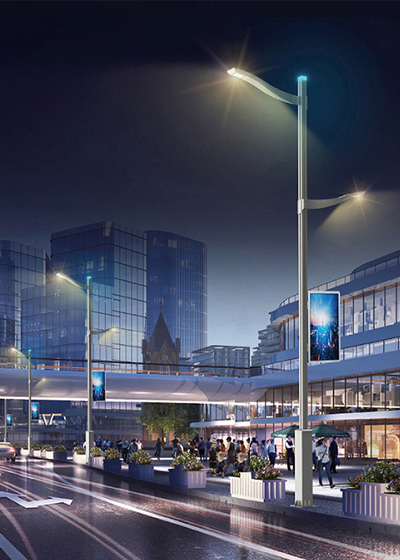


Functions of a Smart Light Pole
Intelligent Lighting Control
Automatic dimming/brightening based on ambient light, time, or motion detection.
Energy-saving LED with remote scheduling and fault alerts.
Environmental Monitoring
Sensors for temperature, humidity, air quality (PM2.5, PM10, CO₂), noise levels, and barometric pressure.
Traffic & People Flow Detection
Cameras or radar to monitor vehicle/pedestrian movement, optimize traffic signals, or count crowds.
Public Wi-Fi Hotspot
Built-in access points to provide internet connectivity in public areas.
Electric Vehicle (EV) Charging
Integrated charging ports for EVs or e-bikes.
Information Display
Digital signage for public announcements, weather, news, or advertisements.
Emergency Communication
One‑touch call buttons, loudspeakers for broadcasts, and emergency lighting.
Security Surveillance
High‑definition cameras with facial recognition, license plate reading, and real‑time alerts.
5G/LTE Small Cell Base Station
Hosting telecommunications equipment to enhance mobile network coverage.
Smart Parking Assistance
Detecting parking space occupancy and guiding drivers via mobile apps or displays.
Effects / Benefits
Energy efficiency – Reduces electricity consumption by up to 70% compared to conventional streetlights.
Lower operational costs – Remote monitoring cuts maintenance trips and labor.
Enhanced public safety – Real‑time video, emergency calls, and adaptive lighting deter crime and improve visibility.
Data‑driven city management – Collects environmental, traffic, and crowd data for better urban planning.
Improved connectivity – Expands Wi‑Fi and cellular coverage in cities.
Reduced carbon footprint – Supports EV charging and lowers energy waste.
Better user experience – Citizens receive real‑time information and feel safer at night.
Scalable smart city foundation – Each pole acts as a multi‑sensor node that integrates with central IoT platforms.