
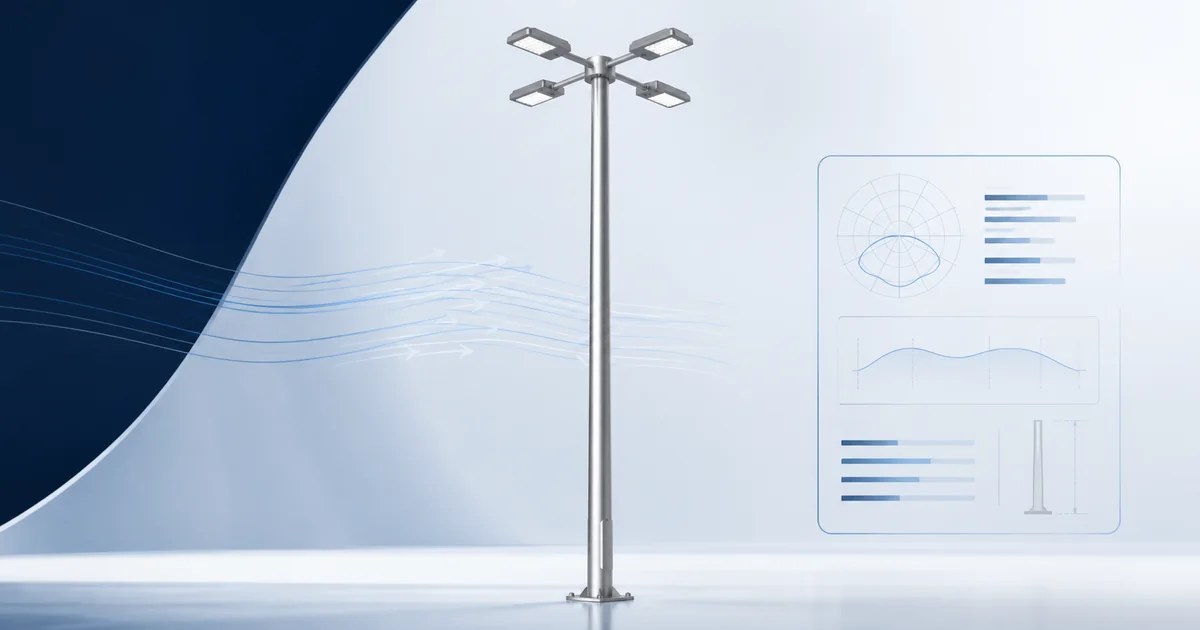
EPA, or effective projected area, is a practical engineering input used when selecting an aluminum light pole. It represents how luminaires, arms, signs, banners and other equipment catch wind. EPA should be considered together with mounting height, shaft geometry, wind criteria, anchorage and foundation conditions. This guide explains how procurement teams can prepare the right information and avoid treating a single EPA number as a universal pole rating.
Why EPA matters
A pole is a complete support system, not only a vertical shaft. Wind acts on the visible equipment above the ground, and the resulting loads travel through the arm, shaft, base or embedded portion, anchorage and foundation. The correct aluminum pole selection therefore starts with the whole assembly.
1. Define EPA correctly
Effective projected area describes the wind-catching demand of fixtures, arms and accessories. It should be taken from the relevant product data where available and considered with the pole shaft itself. It is not a generic strength label that can be copied from one project to another. A reliable inquiry records the information in a fixture schedule and asks the manufacturer to state the assumptions used. That allows designers to compare alternatives on the same basis and helps prevent an attractive pole profile from being selected without a suitable technical configuration. The final system should be reviewed against the project requirements and applicable local standards.
2. List all attachments
A complete list includes every luminaire, arm, sign, banner, camera, solar component and future accessory. Even a small attachment placed high on the shaft can affect the governing load case. The location and direction of each item should be shown, not just its quantity. A reliable inquiry records the information in a fixture schedule and asks the manufacturer to state the assumptions used. That allows designers to compare alternatives on the same basis and helps prevent an attractive pole profile from being selected without a suitable technical configuration. The final system should be reviewed against the project requirements and applicable local standards.
3. Confirm mounting height
Mounting height changes the lever arm between the applied load and the base. A fixture arrangement that is appropriate at one height may need a different shaft or anchorage at another. Define the mounting point clearly, especially when a bracket or arm raises the fixture above the shaft. A reliable inquiry records the information in a fixture schedule and asks the manufacturer to state the assumptions used. That allows designers to compare alternatives on the same basis and helps prevent an attractive pole profile from being selected without a suitable technical configuration. The final system should be reviewed against the project requirements and applicable local standards.
4. Use the project wind criteria
Wind criteria come from the project documents, responsible design team and applicable local requirements. Generic national values may not reflect the exposure, terrain, elevation or special conditions of a site. Record the design basis used for any preliminary pole recommendation. A reliable inquiry records the information in a fixture schedule and asks the manufacturer to state the assumptions used. That allows designers to compare alternatives on the same basis and helps prevent an attractive pole profile from being selected without a suitable technical configuration. The final system should be reviewed against the project requirements and applicable local standards.
5. Review fixture information
Fixture weight and EPA answer different questions. Weight affects gravity loads and lifting, while EPA helps define wind demand. Request the fixture cut sheet, mounting arrangement and EPA value before finalizing an aluminum pole configuration. A reliable inquiry records the information in a fixture schedule and asks the manufacturer to state the assumptions used. That allows designers to compare alternatives on the same basis and helps prevent an attractive pole profile from being selected without a suitable technical configuration. The final system should be reviewed against the project requirements and applicable local standards.
6. Include arm geometry
A tenon, davit arm, mast arm or cross arm creates a different load path. Outreach can increase bending and torsion, so arm length and orientation need to be supplied with the fixture data. A double-arm design should be assessed as a complete assembly rather than two unrelated poles. A reliable inquiry records the information in a fixture schedule and asks the manufacturer to state the assumptions used. That allows designers to compare alternatives on the same basis and helps prevent an attractive pole profile from being selected without a suitable technical configuration. The final system should be reviewed against the project requirements and applicable local standards.
7. Select shaft geometry
Tapered round, straight round, square and custom shafts have different visual and structural geometries. Their allowable attachment arrangements depend on actual dimensions, material, wall thickness and connections. Select the shaft family after the load inputs are understood. A reliable inquiry records the information in a fixture schedule and asks the manufacturer to state the assumptions used. That allows designers to compare alternatives on the same basis and helps prevent an attractive pole profile from being selected without a suitable technical configuration. The final system should be reviewed against the project requirements and applicable local standards.
8. Address alloy and temper
For extruded aluminum light poles, 6063-T6 is commonly used in round shaft applications. The approved drawing should state the material and temper, but material alone does not determine EPA capacity. Geometry, fabrication and installation remain important. A reliable inquiry records the information in a fixture schedule and asks the manufacturer to state the assumptions used. That allows designers to compare alternatives on the same basis and helps prevent an attractive pole profile from being selected without a suitable technical configuration. The final system should be reviewed against the project requirements and applicable local standards.
9. Choose the anchorage early
Anchor-base and direct-burial poles transfer load differently. The base plate, bolts and concrete are integral to one system, while embedment and soil are integral to the other. EPA selection must use the intended anchorage, not a later assumption. A reliable inquiry records the information in a fixture schedule and asks the manufacturer to state the assumptions used. That allows designers to compare alternatives on the same basis and helps prevent an attractive pole profile from being selected without a suitable technical configuration. The final system should be reviewed against the project requirements and applicable local standards.
10. Coordinate the foundation
Foundation dimensions, reinforcement, bolt layout or soil conditions can govern an installation. They must be coordinated with the pole configuration and site requirements. An oversized shaft cannot compensate for an unrelated or unsuitable foundation detail. A reliable inquiry records the information in a fixture schedule and asks the manufacturer to state the assumptions used. That allows designers to compare alternatives on the same basis and helps prevent an attractive pole profile from being selected without a suitable technical configuration. The final system should be reviewed against the project requirements and applicable local standards.
11. Avoid catalog misuse
A catalog table can help compare preliminary options, but its stated wind, height, arm and base assumptions matter. Do not combine an EPA value from one table with a different shaft, fixture or site condition without confirmation. A reliable inquiry records the information in a fixture schedule and asks the manufacturer to state the assumptions used. That allows designers to compare alternatives on the same basis and helps prevent an attractive pole profile from being selected without a suitable technical configuration. The final system should be reviewed against the project requirements and applicable local standards.
12. Plan for future additions
Banners, cameras, antennas and replacement luminaires can alter the loading after installation. If future additions are likely, identify them before production. A review at the concept stage is generally easier than modifying an installed pole. A reliable inquiry records the information in a fixture schedule and asks the manufacturer to state the assumptions used. That allows designers to compare alternatives on the same basis and helps prevent an attractive pole profile from being selected without a suitable technical configuration. The final system should be reviewed against the project requirements and applicable local standards.
13. Document the drawing
The approved drawing should identify shaft dimensions, mounting height, fixtures, arms, base or embedment, access openings, finish and project reference. This creates a common technical record for procurement, installation and future maintenance. A reliable inquiry records the information in a fixture schedule and asks the manufacturer to state the assumptions used. That allows designers to compare alternatives on the same basis and helps prevent an attractive pole profile from being selected without a suitable technical configuration. The final system should be reviewed against the project requirements and applicable local standards.
14. Inspect during installation
Verify the delivered pole and attachments against the approved drawing. Use the specified handling method and do not drill new openings or attach unapproved equipment without review. Field changes may alter the assumptions used for the original selection. A reliable inquiry records the information in a fixture schedule and asks the manufacturer to state the assumptions used. That allows designers to compare alternatives on the same basis and helps prevent an attractive pole profile from being selected without a suitable technical configuration. The final system should be reviewed against the project requirements and applicable local standards.
15. Consider environmental details
Coastal, industrial and high-moisture locations need careful drainage, compatible fasteners and finish selection. These details protect the assembly over time but do not replace structural selection for the specified wind and attachments. A reliable inquiry records the information in a fixture schedule and asks the manufacturer to state the assumptions used. That allows designers to compare alternatives on the same basis and helps prevent an attractive pole profile from being selected without a suitable technical configuration. The final system should be reviewed against the project requirements and applicable local standards.
16. Compare quotations fairly
Compare dimensions, alloy-temper, wall thickness, arm arrangement, finish, anchorage and stated design inputs. Price differences often reflect different assumptions. An equivalent comparison requires equivalent fixtures, EPA and installation conditions. A reliable inquiry records the information in a fixture schedule and asks the manufacturer to state the assumptions used. That allows designers to compare alternatives on the same basis and helps prevent an attractive pole profile from being selected without a suitable technical configuration. The final system should be reviewed against the project requirements and applicable local standards.
17. Use a staged process
Concept selection can use preliminary data, then a fixture schedule and final design criteria can support a project-specific drawing. This staged process avoids releasing a pole before the critical attachment information is known. A reliable inquiry records the information in a fixture schedule and asks the manufacturer to state the assumptions used. That allows designers to compare alternatives on the same basis and helps prevent an attractive pole profile from being selected without a suitable technical configuration. The final system should be reviewed against the project requirements and applicable local standards.
Practical specification workflow
- Collect fixture cut sheets, weight and EPA information.
- Define mounting height, arms, orientation and accessory locations.
- Confirm the project wind criteria and intended anchorage.
- Request a drawing for the complete aluminum pole assembly.
- Coordinate foundation or embedment details before release.
Use our light pole wind load calculation guide to prepare the main inputs. Review direct burial versus anchor base poles when choosing installation. For material and custom-shaft options, visit our aluminum light pole page.
Frequently asked questions
Is a higher EPA always better?
Not necessarily. The required capacity should match the actual assembly and project conditions. A higher value may involve a different shaft, base or foundation and should be selected for a documented need.
Can a banner be added later?
It should be reviewed first because it changes the wind loading and may not be within the original design assumptions.
Conclusion
EPA connects lighting equipment to pole engineering. By documenting fixtures, arms, accessories, wind criteria and anchorage before production, buyers can obtain a more accurate aluminum pole drawing and avoid costly late changes.