
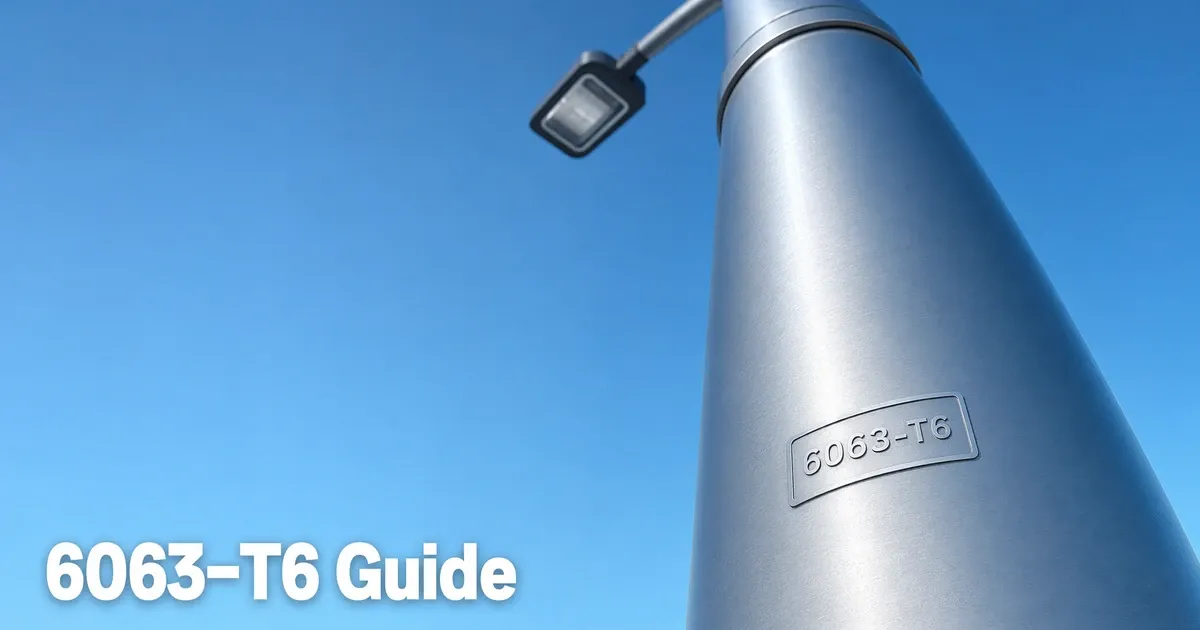
6063-T6 aluminum is widely associated with extruded architectural and structural profiles. For light poles, its value comes from the combination of extrudability, surface quality, corrosion resistance and useful mechanical strength. The alloy designation alone, however, does not prove that a pole is suitable for a project; geometry, wall thickness, temper control, welding and wind-load design remain essential.
What does 6063-T6 mean?
“6063” identifies an aluminum-magnesium-silicon alloy family. “T6” describes a heat-treatment condition involving solution treatment and artificial aging to develop strength. Material certificates and applicable product standards should be used to confirm the supplied composition and properties.
Why use 6063-T6 for light poles?
Extrusion capability
Extrusion allows manufacturers to produce controlled hollow profiles and integrated decorative features. This supports tapered, fluted or specialized pole designs while maintaining a consistent external appearance.
Corrosion resistance
Aluminum naturally forms a protective oxide layer. With appropriate design and finishing, it performs well in many outdoor environments and avoids the red rust associated with unprotected carbon steel.
Surface finish
6063 is known for good finishing quality. Natural or colored anodizing and powder coating can provide different appearances and protection levels. Coastal projects still require exposure-specific design; read our coastal corrosion protection guide.
Low weight
Aluminum’s lower density can simplify handling and installation. Lifting procedures must still protect the finished surface and prevent local deformation.
Design details that matter
- Shaft profile, taper and minimum wall thickness
- Heat-affected zones near welds
- Base plate and access-door reinforcement
- Attachment EPA and design wind speed
- Electrical access and grounding requirements
- Isolation from dissimilar metals
Welding can alter local temper and mechanical properties. Structural calculations should use appropriate material values for the actual fabrication condition.
6063-T6 compared with other aluminum alloys
Other 6xxx-series alloys may offer different strength, fabrication or availability advantages. The correct choice depends on the manufacturing method and engineering standard. Buyers should avoid assuming that the highest nominal strength automatically provides the best pole; extrusion quality, welding procedure and complete structural design are equally important.
How to specify a 6063-T6 pole
State the applicable standard, pole height, shaft geometry, mounting system, finish, wind criteria and complete attachment schedule. Request material traceability and drawings appropriate to the project.
Explore Yaolong’s 6063-T6 aluminum light poles, including tapered, curved, direct-burial and arm configurations. For project engineering and finish options, contact our team.