
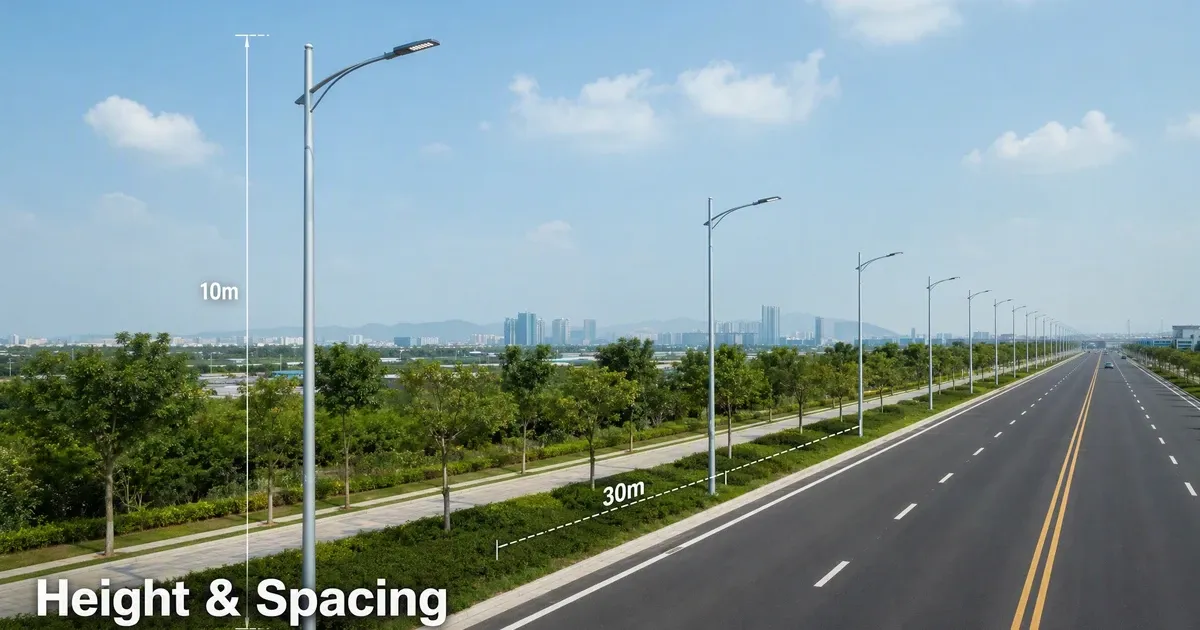
Street light pole height and spacing must be selected together with the luminaire and road geometry. A fixed spacing rule cannot guarantee compliant lighting because output, optical distribution, lane width, setbacks, tilt and surface reflectance all affect the result. A photometric calculation should confirm the final layout.
Factors that determine mounting height
Road classification and width
Local streets, collectors, arterial roads and intersections have different visual tasks and lighting criteria. Wider roads may require taller poles, longer outreach arms, median mounting or arrangements on both sides.
Luminaire output and distribution
Two luminaires with the same wattage can produce different road patterns. Use the manufacturer’s photometric file and maintenance assumptions rather than wattage alone.
Required uniformity and glare control
Increasing spacing may reduce pole quantity but can create dark areas between poles. Very low mounting heights may increase glare and require closer spacing. The design must balance average illumination, uniformity, threshold increment and other criteria required by the governing standard.
Common layout arrangements
- Single-sided: often considered for narrower roads.
- Staggered: alternating poles may improve coverage on medium-width roads.
- Opposite: paired poles can support wider carriageways.
- Median: central mounting may serve both directions where the road geometry permits.
Spacing-to-height ratio as an early concept
Designers sometimes use a spacing-to-mounting-height ratio for preliminary planning, but the acceptable ratio depends on the luminaire distribution and performance targets. It should never replace a point-by-point lighting calculation.
Information needed for a photometric layout
- Road and sidewalk dimensions
- Pole setback and allowable positions
- Luminaire IES or LDT file
- Mounting height, outreach and tilt
- Target illuminance or luminance criteria
- Maintenance factor and surface data
Structural coordination
Once the lighting layout is selected, verify the pole against wind speed, fixture EPA, arm length and any additional attachments. Foundation and underground utility conflicts should be coordinated before positions are finalized.
Choose the right street lighting pole
Yaolong manufactures street light poles in aluminum, steel and stainless-steel configurations, with single arms, double arms and custom outreach options. Review the aluminum pole range or send your road layout, fixture data and wind criteria through our contact page.