
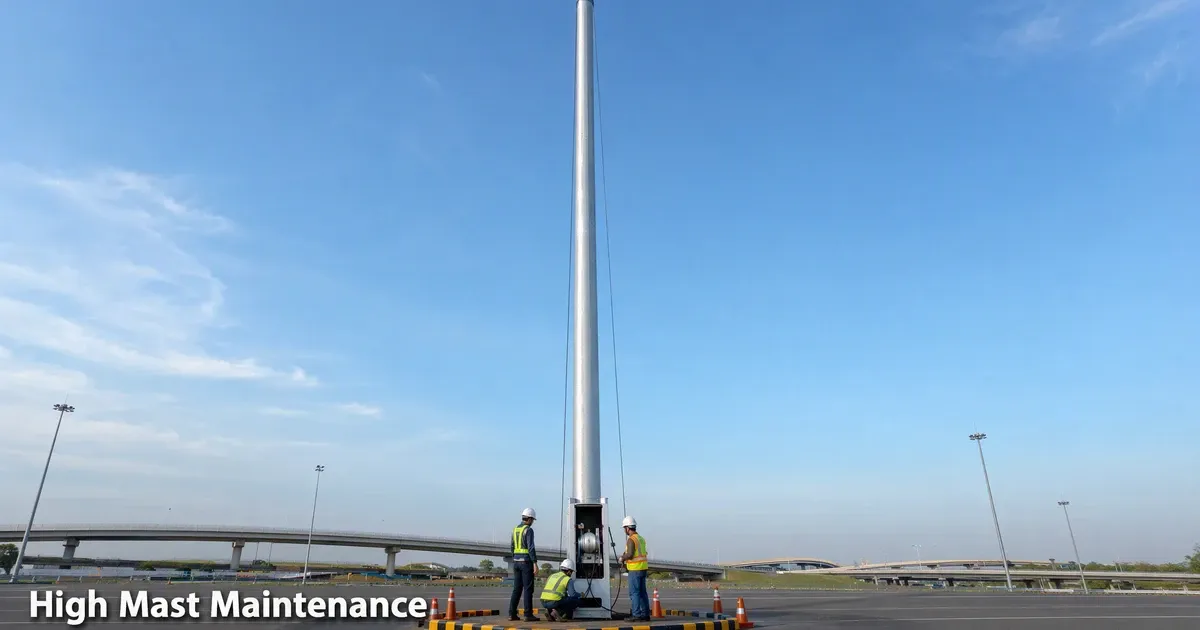
High mast lighting places multiple luminaires at substantial height, often above highways, ports, airports and large industrial areas. A planned maintenance program improves reliability and helps identify corrosion, fatigue, electrical or lowering-system problems before they become serious.
Create a site-specific maintenance plan
Inspection frequency should reflect manufacturer instructions, local regulations, environmental exposure, operating hours and the consequences of failure. Coastal, industrial and high-wind sites may require more frequent checks. Keep drawings, equipment manuals, test records and previous inspection photographs together.
Safety before maintenance
- Establish traffic and work-zone control
- Apply lockout/tagout procedures
- Verify weather and wind limits
- Inspect lifting and lowering equipment before use
- Use trained personnel and appropriate fall protection
- Keep the area below the mast clear
Foundation and base inspection
Check concrete for cracking, settlement, spalling and standing water. Inspect anchor bolts, nuts, washers, grout and base details for corrosion, looseness or deformation. Do not simply retighten structural fasteners without the specified procedure and torque requirements.
Shaft and access-door inspection
Inspect the mast for impact damage, coating failure, corrosion, unusual movement and visible weld defects. Confirm access doors close securely and gaskets, locks and internal barriers remain functional. Suspected structural damage requires engineering evaluation.
Lowering-system maintenance
For lowering masts, inspect winches, cables, pulleys, latches, guides and head-frame components according to the manufacturer’s manual. Watch for broken wires, corrosion, flattening, wear, poor spooling or abnormal noise. Functional testing should occur under controlled conditions.
Luminaire ring and electrical equipment
- Check luminaires, brackets and fasteners
- Clean lenses and replace failed components
- Inspect cables, connectors, junction boxes and grounding
- Confirm the ring seats and latches correctly
- Record insulation or electrical test results where required
When specialist assessment is needed
Consult qualified engineers or service specialists after vehicle impact, extreme wind, lightning, foundation movement, repeated cable damage, severe corrosion or any observed crack or deformation.
Specify maintainability from the start
Maintenance access, lowering-system type, spare parts and corrosion protection should be considered during procurement—not after installation. Explore Yaolong’s high mast lighting systems and discuss project height, luminaire quantity, wind criteria and maintenance strategy through our contact page.