
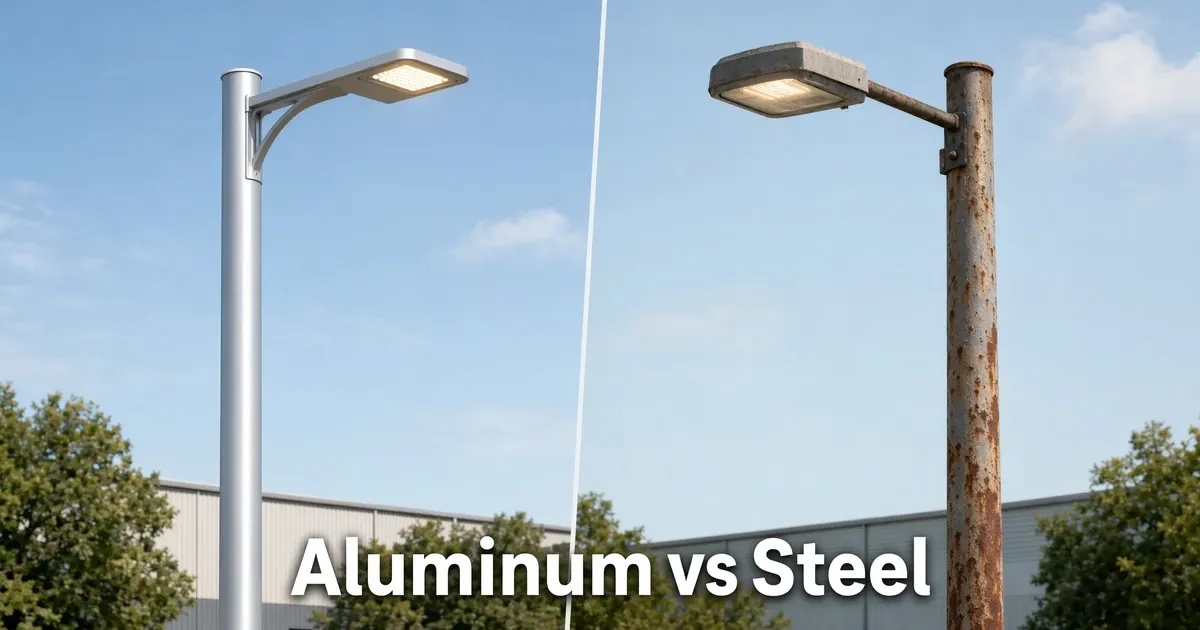
Choosing between aluminum light poles and steel light poles is an important decision for roadway, commercial, municipal, coastal, and landscape lighting projects. Both materials can provide reliable structural support, but they differ significantly in corrosion resistance, weight, strength, maintenance requirements, service life, and total project cost.
This guide compares the main advantages and disadvantages of aluminum and steel light poles to help engineers, contractors, developers, and purchasing teams select the right option for their application.
Quick Comparison: Aluminum vs. Steel Light Poles
| Factor | Aluminum Light Poles | Steel Light Poles |
|---|---|---|
| Corrosion resistance | Excellent natural resistance | Requires galvanizing, coating, or regular protection |
| Weight | Lightweight | Heavier |
| Installation | Easier handling and lower lifting requirements | Often requires heavier lifting equipment |
| Strength and stiffness | Good for many standard applications | High strength and stiffness for heavy-duty designs |
| Maintenance | Generally low | Depends strongly on coating condition and environment |
| Initial cost | Usually higher | Usually lower |
| Recyclability | Highly recyclable with strong scrap value | Highly recyclable |
| Typical applications | Coastal areas, decorative projects, parking lots, urban streets | Highways, high-mast lighting, industrial sites, heavy-duty projects |
Advantages of Aluminum Light Poles
1. Excellent Corrosion Resistance
Aluminum naturally forms a protective oxide layer when exposed to air. This layer helps resist corrosion without relying entirely on an applied coating. As a result, aluminum poles are especially attractive for coastal areas, humid climates, locations exposed to road salt, and other corrosive environments.
Additional anodizing or powder coating can improve appearance and provide extra surface protection when required by the project specification.
2. Lightweight and Easier to Install
Aluminum is substantially lighter than steel. The lower weight can simplify transportation, unloading, positioning, and installation. In many projects, this may reduce crane capacity requirements, labor effort, and installation time. Lightweight poles are also easier to handle in locations with restricted access.
3. Low Maintenance Requirements
Because aluminum offers inherent corrosion resistance, it typically needs less maintenance than unprotected or poorly maintained steel. There is less risk of red rust, and minor surface damage does not expose the pole to corrosion in the same way that damaged paint can expose carbon steel.
4. Clean Appearance and Flexible Finishes
Aluminum light poles provide a modern, clean appearance. They can be supplied with a natural satin finish, anodized surface, brushed texture, or powder-coated color. Extrusion and forming processes also allow manufacturers to produce tapered, fluted, and decorative profiles for architectural applications.
5. Long-Term Value and Recyclability
Although the initial purchase price may be higher, lower maintenance needs and good corrosion performance can make aluminum cost-effective over the complete service life of the pole. Aluminum is also highly recyclable and generally retains useful material value at the end of its life.
Disadvantages of Aluminum Light Poles
1. Higher Initial Material Cost
Aluminum poles usually cost more to purchase than comparable standard steel poles. For projects driven mainly by the lowest upfront price, this difference can be significant.
2. Lower Stiffness Than Steel
Aluminum has a lower modulus of elasticity than steel, which means it can deflect more under the same load. Proper engineering is essential, particularly for tall poles, long outreach arms, large luminaires, high wind zones, and installations carrying signs, banners, cameras, or other accessories.
3. Greater Sensitivity to Fatigue and Heat
Pole design must account for cyclic wind loading and fatigue at welded connections. Aluminum also loses strength more rapidly at elevated temperatures, which may be relevant in certain industrial or fire-sensitive environments.
4. Galvanic Corrosion Must Be Controlled
When aluminum directly contacts dissimilar metals in the presence of moisture, galvanic corrosion can occur. Correct fasteners, isolation washers, protective compounds, and installation practices should be used at the base plate, anchor bolts, access door, and luminaire connections.
Advantages of Steel Light Poles
1. High Strength and Stiffness
Steel provides excellent strength and stiffness, making it suitable for tall poles, high-mast systems, large outreach arms, heavy luminaires, and installations with additional equipment. It is widely used for highways, ports, airports, industrial facilities, stadiums, and other demanding applications.
2. Competitive Initial Cost
Steel is widely available, and steel pole manufacturing is mature and efficient. Standard galvanized or painted steel poles often have a lower initial purchase price than aluminum alternatives, which can benefit large projects with strict capital budgets.
3. Broad Manufacturing Flexibility
Steel can be formed into round, square, polygonal, tapered, and stepped pole designs. Welding, drilling, bracket fabrication, and customization are well-established, giving designers considerable flexibility for structural and accessory requirements.
4. Proven Performance
Properly designed, fabricated, galvanized, coated, installed, and maintained steel poles can provide decades of service. Their mechanical behavior is well understood, and engineers have extensive design experience with steel structures.
Disadvantages of Steel Light Poles
1. Susceptibility to Corrosion
Carbon steel can rust when exposed to moisture and oxygen. Hot-dip galvanizing, paint, powder coating, or duplex protection is therefore essential in many environments. Corrosion risk is especially high near the pole base, around access doors, in coastal locations, and where deicing salt or standing water is present.
2. Higher Transportation and Installation Weight
Steel poles are heavier than aluminum poles of similar size. This can increase freight weight, unloading effort, crane requirements, foundation handling, and installation time. The impact becomes more noticeable on tall or large-diameter poles.
3. Coating Inspection and Maintenance
The performance of a steel pole often depends on the integrity of its protective coating. Scratches, poor drainage, installation damage, or aging paint can allow corrosion to begin. Periodic inspection and repair may be required, particularly in aggressive environments.
4. Potentially Higher Life-Cycle Maintenance Cost
A low initial price does not always mean the lowest total ownership cost. Repainting, corrosion repair, traffic control for maintenance, and eventual replacement should be included when comparing alternatives over the project life.
Which Material Should You Choose?
The best choice depends on the environment, structural loads, budget, expected service life, appearance, and maintenance strategy.
- Choose aluminum light poles when corrosion resistance, low weight, minimal maintenance, architectural appearance, or coastal performance is the priority.
- Choose steel light poles when high strength, stiffness, heavy accessory loads, tall structures, or a lower initial cost is the priority.
Neither material is automatically better for every project. A complete comparison should consider wind speed, pole height, luminaire effective projected area, bracket configuration, local standards, foundation design, surface protection, and site exposure. The final pole should always be verified by a qualified engineer and manufactured to the applicable project specifications.
Conclusion
Aluminum light poles offer strong corrosion resistance, easy handling, low maintenance, and an attractive finish, while steel light poles provide high strength, stiffness, manufacturing versatility, and a competitive initial cost. Evaluating both the upfront investment and long-term maintenance requirements will help project teams select a safe, durable, and economical lighting solution.